Priority-driven solver with human tending action/mode added. More...
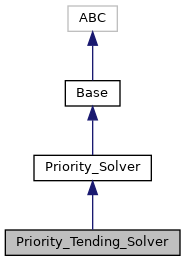
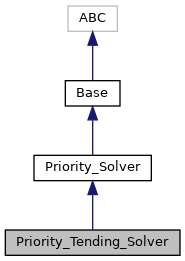
Public Member Functions | |
| def | __init__ (self, CfgSolver cfgSolver) |
| Constructor for Priority Tending Solver instance. More... | |
| def | getNextAction (self, ImageRGBD rgbd=None, StatePuzzleScene scene=None) |
| Return the next action to execute from current solver state. More... | |
| def | getNextOperation (self, StatePuzzleScene scene, ImageRGBD rgbd) |
| Compute the composite priority of each operation and return the operation with highest composite priority. More... | |
| def | reset_solver (self) |
| Reset the solver to begin with a new puzzle or start. More... | |
 Public Member Functions inherited from Priority_Solver Public Member Functions inherited from Priority_Solver | |
| def | computePlacePlan (self, StatePuzzleScene scene, ImageRGBD rgbd) |
| Computes a custom place plan. More... | |
| def | updatePriorities (self) |
| Update priorities by snagging from ROS1 dynamic parameter server. More... | |
| Public Member Functions inherited from Base | |
| def | checkIDplaceability (self, solID) |
| Checks if piece with solID can be placed must have an adjacent placed piece, or should be on an edge/corner. More... | |
| def | createMeasuredBoard (self, ImageRGBD rgbd, StatePuzzleScene scene, List[int] zones) |
| Take in raw inputs and create (generic) board measurement. More... | |
| def | createSolutionBoard (self, int zone_to_match) |
| Create a solution board based on the zone we want to match against. More... | |
| def | getNextAction (self) |
| Return the next action to execute from current solver state. More... | |
| def | getSequentialPlan (self, measured_board, solution_board, numPieces) |
| Generate a sequential placement plan by sorting matched pieces by solution ID. More... | |
| def | isBoardSolved (self) |
| Check if all puzzle pieces are in place. More... | |
| def | isPieceThere (self, meaPiece, StatePuzzleScene scene) |
| Check if the measured piece is actually present in the scene by analyzing the segmentation mask. More... | |
| def | performMatching (self, Arrangement measured_board, SolutionBoard solution_board) |
| Perform correspondence tracking to find a piece to direct place. More... | |
| def | reset_estimate_board (self) |
| Set the estimate board to all pieces unsolved, based on the solution board. More... | |
| def | updateSolutionRegEstimate (self, StatePuzzleScene scene) |
| Review pieces in solution region and update estimate. More... | |
Public Attributes | |
| mode | |
| PIECES_BEFORE_LOOK | |
| PIECES_BEFORE_TEND | |
| state | |
| Public Attributes inherited from Priority_Solver | |
| dir_place_pty | |
| mode | |
| PIECES_BEFORE_LOOK | |
| place_pty | |
| sort_pty | |
| state | |
| zones_to_estimate | |
| Public Attributes inherited from Base | |
| board_estimate | |
| Board estimate from state history. More... | |
| cfgMatching | |
| Correspondences configs. More... | |
| correspondence_tracker | |
| Puzzle piece correspondence tracker. More... | |
| display | |
| Debug display. More... | |
| imRegions | |
| Region definitions for puzzle zones. More... | |
| mode | |
| Higher level mode regulating activities. More... | |
| puzzle_params | |
| Puzzle-specific parameters for arrangement building. More... | |
| reference_board | |
| Solution reference. More... | |
| state | |
| Internal activity state. More... | |
| verbose | |
| Verbosity level. More... | |
Additional Inherited Members | |
| Static Public Attributes inherited from Base | |
| int | NUM_ZONES = 4 |
| int | SOL = 5 |
| int | UNORGANIZED = 6 |
Detailed Description
Priority-driven solver with human tending action/mode added.
Augment Priority_Solver with a worker tending mode. Not much changes except for the fact that the robot provides an opportunity for the human worker to fix the puzzle pieces to improve their arrangement (in the sort zones or in the solution proper) before proceeding.
Constructor & Destructor Documentation
◆ __init__()
| def __init__ | ( | self, | |
| CfgSolver | cfgSolver | ||
| ) |
Constructor for Priority Tending Solver instance.
- Parameters
-
[in] cfgSolver Configuration for the solver, including reference board and parameters.
Reimplemented from Priority_Solver.
Member Function Documentation
◆ getNextAction()
| def getNextAction | ( | self, | |
| ImageRGBD | rgbd = None, |
||
| StatePuzzleScene | scene = None |
||
| ) |
Return the next action to execute from current solver state.
- Parameters
-
[in] rgbd RGBD image for the current scene. [in] scene Current scene state.
- Returns
- Action to take.
- Note
- Uses a two-mode state machine: PERCEIVE - handles tending (human help) and looking (scene estimation). Tending is requested first so the human can fix pieces before the robot re-estimates the scene. ACT - executes sort / place / direct-place operations. The tend counter decrements only after an actual action. When it hits zero or the piece list is exhausted, mode switches back to PERCEIVE.
Reimplemented from Priority_Solver.
◆ getNextOperation()
| def getNextOperation | ( | self, | |
| StatePuzzleScene | scene, | ||
| ImageRGBD | rgbd | ||
| ) |
Compute the composite priority of each operation and return the operation with highest composite priority.
- Parameters
-
[in] rgbd RGBD image for the current scene. [in] scene Current scene state.
- Returns
- Tuple: List of pieces, Next operation state
- Note
- This code essentially duplicates the same code in priority solver which causes problems when there are mistakes. Common elements should go into a common member function. It complicates understanding but simplifies gross changes. That's more important when developing and iterating towards final implementation. 2026/08/02 - PAV.
Reimplemented from Priority_Solver.
◆ reset_solver()
| def reset_solver | ( | self | ) |
Reset the solver to begin with a new puzzle or start.
Resets the board estimate to all pieces unsolved, based on the solution board. Also resets the state and mode.
Reimplemented from Priority_Solver.
Member Data Documentation
◆ mode
| mode |
◆ PIECES_BEFORE_LOOK
| PIECES_BEFORE_LOOK |
◆ PIECES_BEFORE_TEND
| PIECES_BEFORE_TEND |
◆ state
| state |
The documentation for this class was generated from the following file:
- /home/mary/python/puzzle_solver/puzzle/solver/priority_tending.py